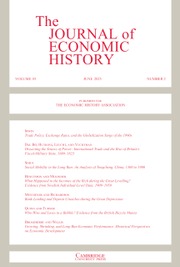
-
作者:Santa Clara University; Claremont Colleges; Claremont Graduate University; Claremont McKenna College
摘要:The Baring Crisis is the nineteenth century's most famous sovereign debt crisis. Using a database of more than 15,000 observations, we assess its effect on emerging market borrowers and find empirical evidence of a regional crisis but not a global crisis. During the crisis, Latin American yield spreads increased by more than 200 basis points relative to the rest of the world, even after controlling for macroeconomic, trade, political-institutional factors, and other country-specific effects. O...
-
作者:Columbia University
-
作者:University of Oxford
摘要:A biological model of nitrogen in agriculture is specified for early modem England and used to analyze the growth in grain yields from the middle ages to the industrial revolution. Nitrogen-fixing plants accounted for about half of the rise in yields; the rest came from better cultivation, seeds, and drainage. The model highlights the slow chemical reactions that governed the release of the nitrogen introduced by convertible husbandry and the cultivation of legumes. However efficient were Engl...
-
作者:Vanderbilt University
-
作者:University of California System; University of California Merced
-
作者:William & Mary
-
作者:Macalester College
摘要:The rapid development of the nationwide telephone network following the expiration of the Bell patents in 1894, along with expansion of private wire telegraph networks, created the nerve center necessary for rapid growth in the decentralized, dealer-intermediated, over-the-counter security markets. Using membership roles from the National Quotation Bureau-the predecessor of the NASDAQ-I link growth in the number of dealers to the expansion of these communication networks prior to World War I. ...
-
作者:Rensselaer Polytechnic Institute; University of California System; University of California San Diego; University of California System; University of California Berkeley
-
作者:Universita Ca Foscari Venezia
摘要:From the mid-sixteenth to the early seventeenth century, Genoese bankers collected money from a variety of sources and lent it to the king of Spain. It was all made possible by the Bisenzone exchange fairs, which created an efficient financial network under Genoese control and permitted arbitrage among nor-them Italian financial markets. At Bisenzone, Genoese bankers raised money for these loans from a variety of sources, which reduced the risks of lending and funded the king's long-term oblig...
-
作者:University of Wisconsin System