GDP growth in the G20 area was unchanged at 0.7% in the first quarter of 2026, according to provisional estimates. This reflects a mixed picture across G20 countries for which data was available.
Download in PDF (data tables included)
GDP (Gross Domestic Product) growth in the G20 area was unchanged at 0.7% in the first quarter of 2026, according to provisional estimates (Figure 1). This reflects a mixed picture across G20 countries for which data was available.
Among G20 economies, growth accelerated in most countries in Q1 2026. GDP growth rebounded strongly in Korea, from -0.1% in Q4 2025 to 1.8% in Q1 2026, and picked up significantly in Brazil, from 0.3% to 1.1%. Growth also accelerated, though more modestly, in the United Kingdom (from 0.2% to 0.6%), Japan (from 0.2% to 0.5%), the United States (from 0.1% to 0.4%), India (from 1.8% to 1.9%), China (from 1.2% to 1.3%), South Africa (from 0.4% to 0.5%) and Germany (from 0.2% to 0.3%). Growth remained strong in Indonesia (at 1.4%) and was also unchanged in Italy (at 0.3%). Canada recorded zero growth following a contraction of 0.2% in Q4 2025.
By contrast, GDP growth weakened in five G20 countries with available data. Saudi Arabia recorded the largest decline, with GDP contracting by 1.2% in Q1 2026 after growth of 1.3% in the previous quarter, mainly driven by the decline in oil activities.1 Mexico also saw a large contraction (-0.6% after 0.7% growth in the previous quarter), while GDP declined more moderately in France (-0.1% after 0.2% growth). Growth also slowed in Türkiye (from 0.4% to 0.1%) and Australia (from 0.9% to 0.3%).
Compared with the same quarter of the previous year, GDP in the G20 area was 3.2% higher in Q1 2026 (Table 2). Among G20 economies with available data, India recorded the highest year-on-year growth rate at 8.0%, while Canada recorded the lowest at -0.1%.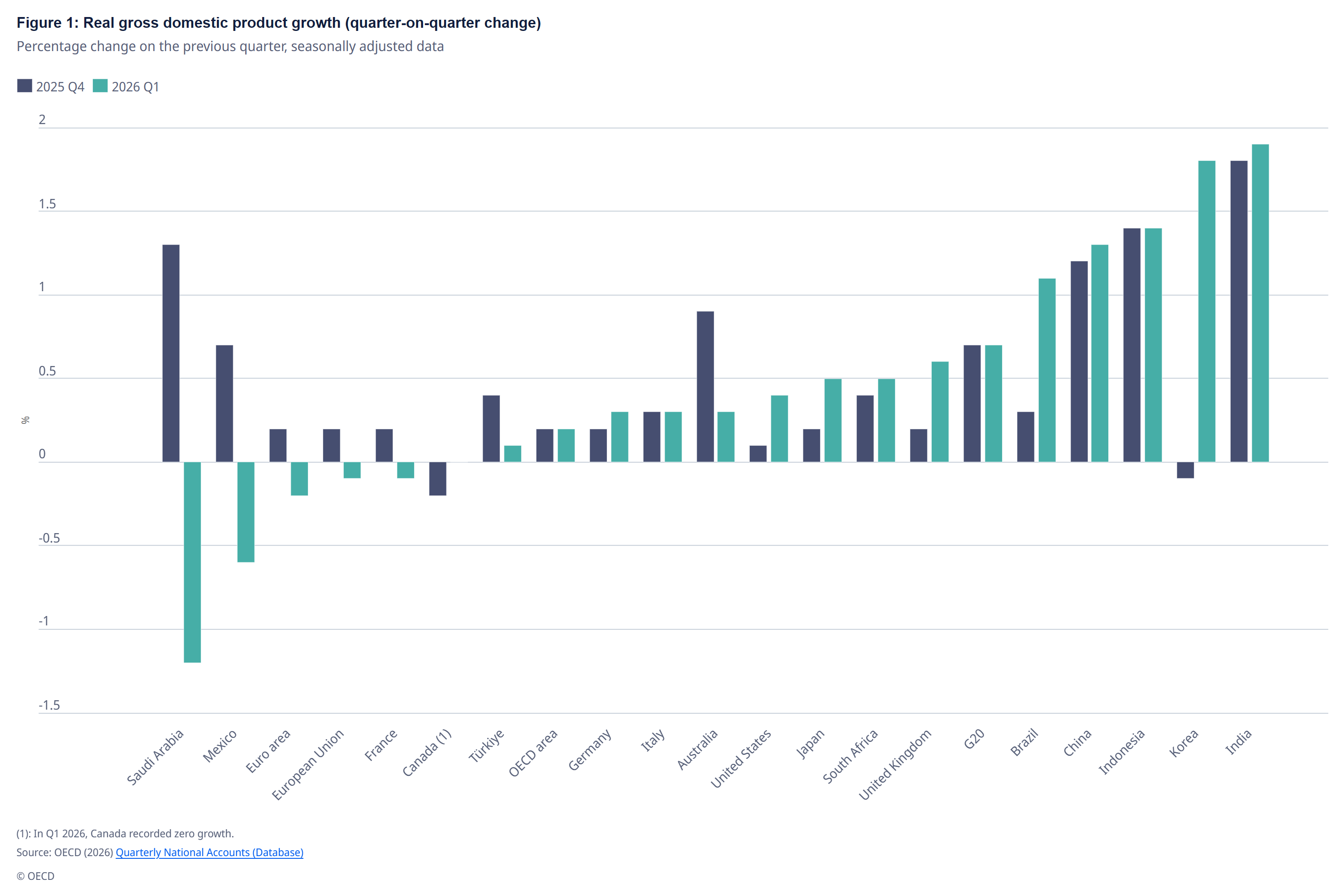
Note:
- Oil activities include the extraction of crude oil and natural gas and refining activities.
Methodology
Release dates
- Next release: 14 September 2026
- All releases dates
Contact us
For further information, journalists are invited to contact the OECD's Media Relations Division on (33) 1 45 24 97 00; others should contact the Statistics and Data Directorate