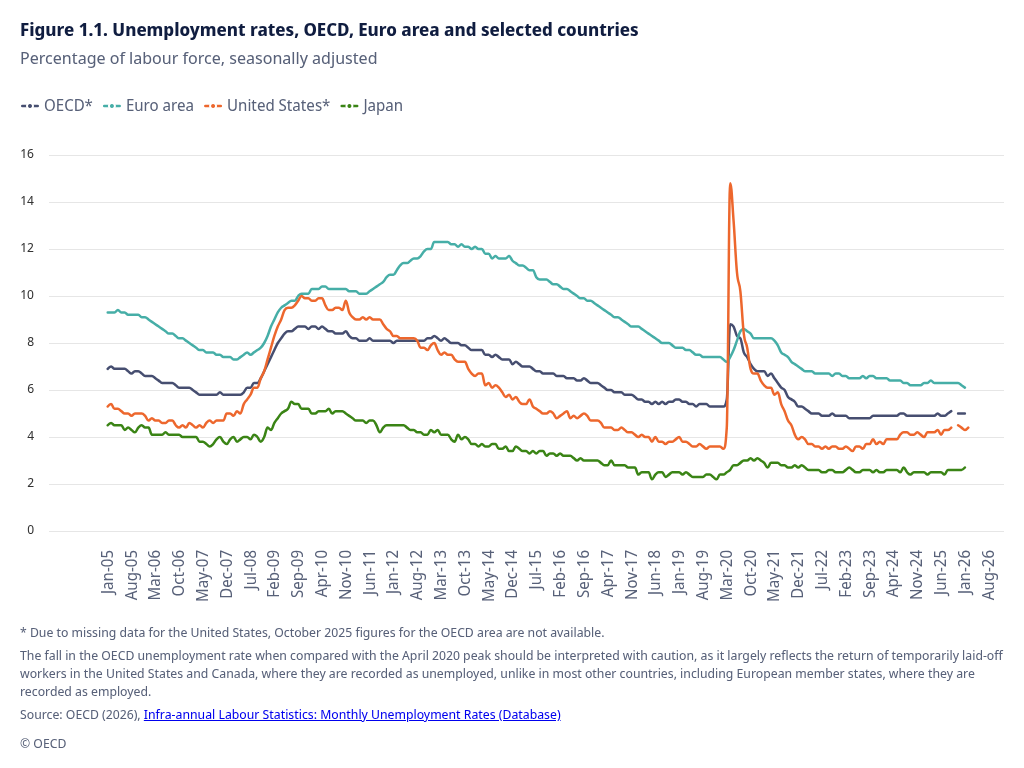
The OECD unemployment rate remained stable at 5.0% in January 2026, having been at or just below this mark since April 2022.
Download in PDF (data tables included)
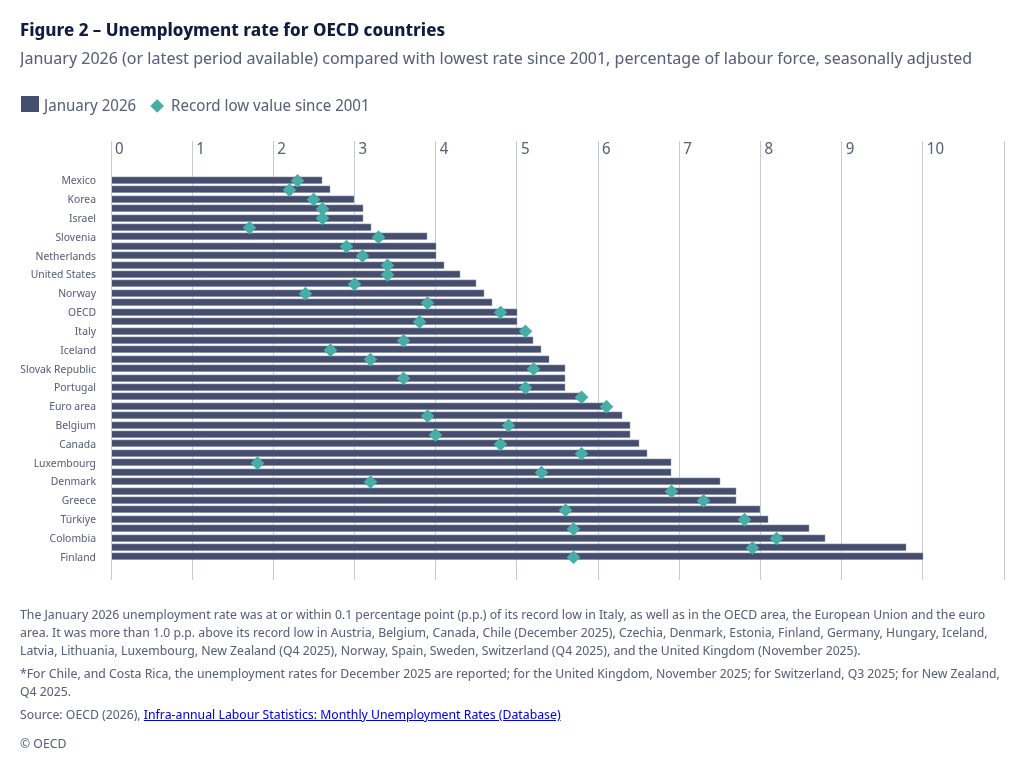
The OECD unemployment rate remained stable at 5.0% in January 2026, having been at or just below this mark since April 2022 (Figure 1).1 Compared with December 2025, the unemployment rate held steady in the majority of OECD countries with available data (18 of the 33). It fell in 11 countries, while it rose in Colombia, Denmark, Norway and Türkiye. Japan, Korea and Mexico recorded unemployment rates of 3.0% or below. Finland was the only OECD country to report a double-digit unemployment rate, while Spain’s rate fell below 10% for the first time since March 2008 (Table 1). In January 2026, the number of unemployed individuals in the OECD declined slightly from December 2025 to 34.9 million but stood half a million above the level recorded in January 2025 (Table 2).
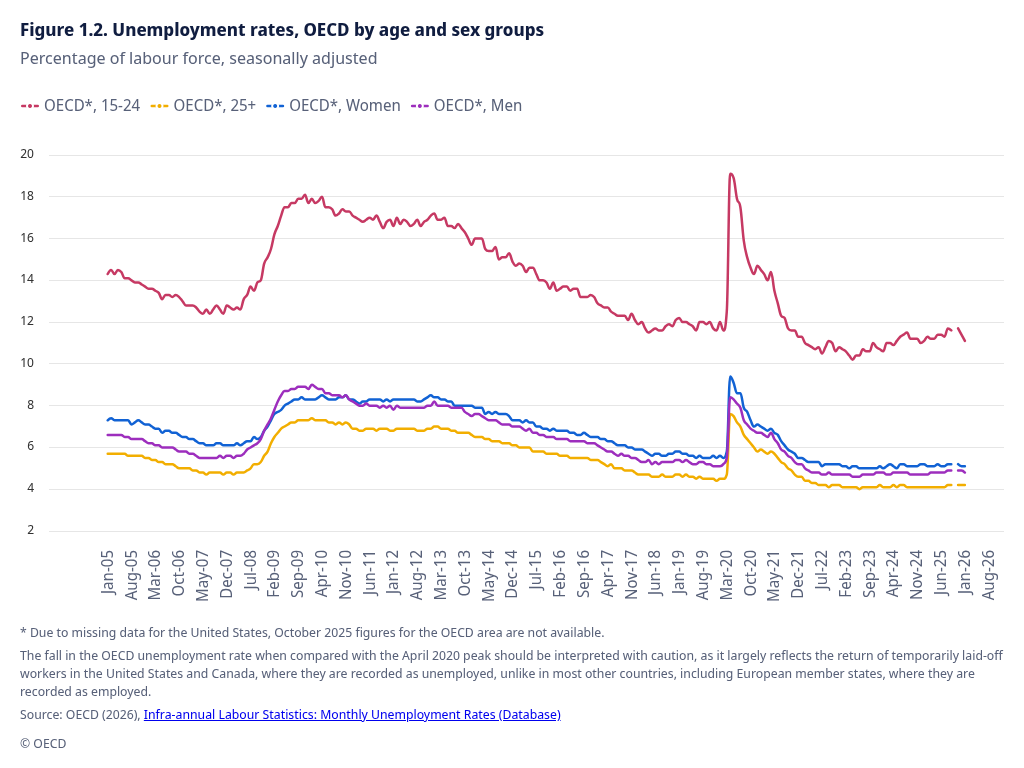
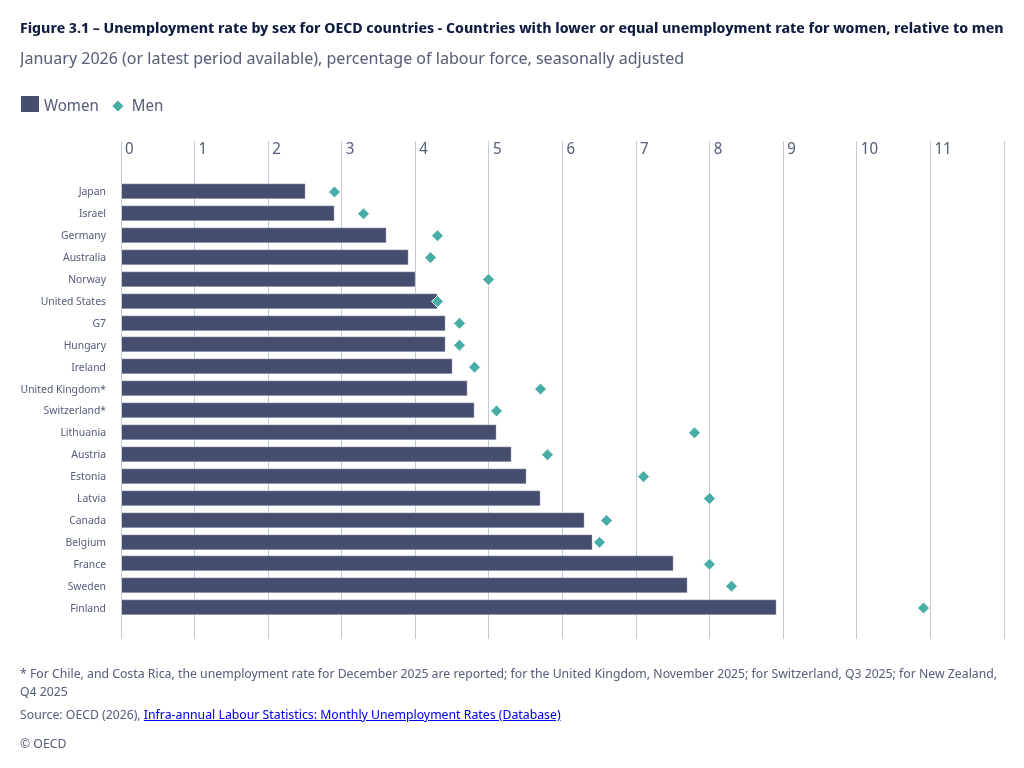
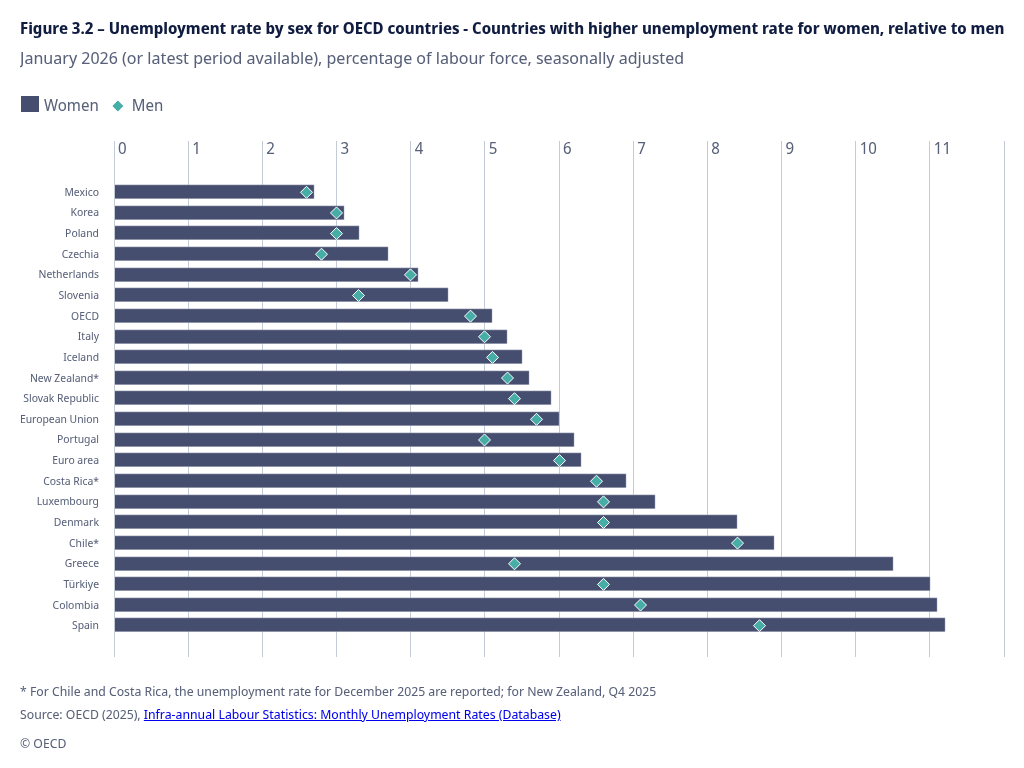
In January 2026, the OECD unemployment rate for women and men remained broadly stable, at 5.1% and 4.8%, respectively. The unemployment rate for women exceeded that of men in the European Union, the euro area, and 19 OECD countries in January 2026 (or in the latest available period), with the largest gender gaps (3.7 percentage points (p.p.) and higher) observed in Colombia, Greece, and Türkiye (Figure 3 and Table 3). The age gap in unemployment in the OECD decreased by 0.3 p.p. to 6.9 p.p., driven by a decline in the youth unemployment rate (aged 15-24) (Table 4).
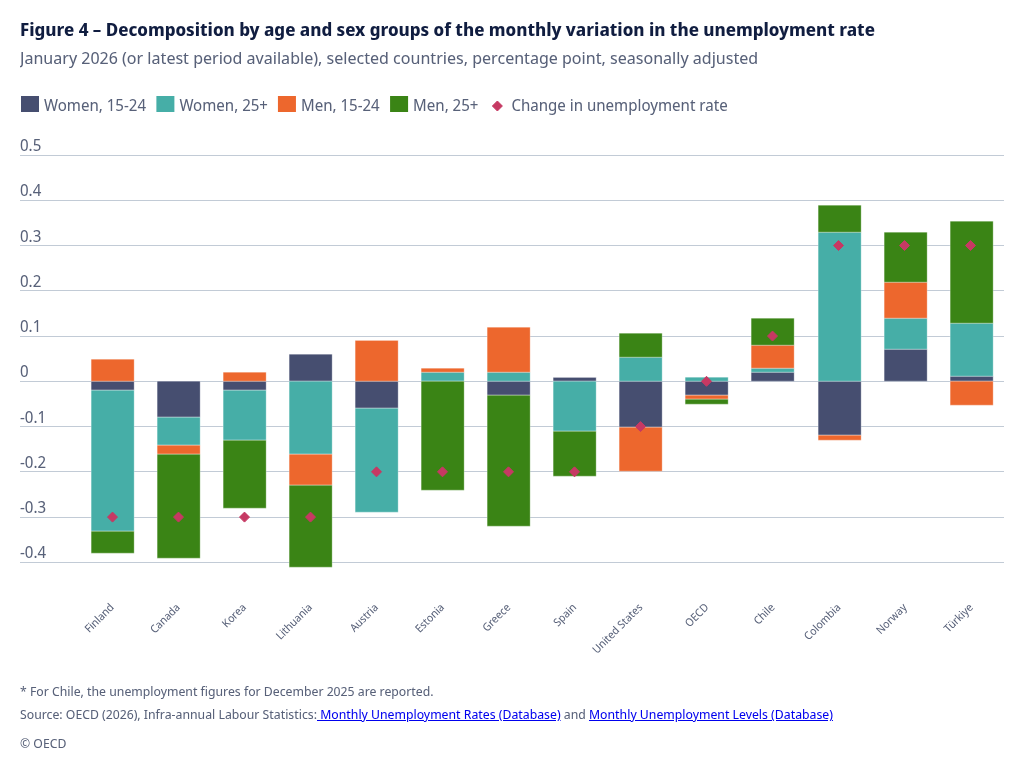
In January 2026, unemployment rates in both the European Union (5.9%) and the euro area (6.1%) remained broadly stable compared with December 2025, matching their record lows. The unemployment rate remained stable in nine OECD euro area countries while it decreased in eight others, including Italy where it reached its lowest level (5.1%) since the current series began in 2004. The decline in unemployment rates in Austria and Finland was mainly driven by a decrease in unemployment among women aged 25 and over, whereas in Estonia and Greece it was driven by a decline in unemployment among men aged 25 and over (Figure 4).
Outside the euro area, the unemployment rate was stable in January 2026 for the nine OECD countries with available data. Denmark recorded the largest month-on-month increase, reaching 7.4%, its highest level since January 2004, primarily due to a 2.6 p.p. increase in the unemployment rate for women. By contrast, Canada, Korea and Sweden recorded decreases in the unemployment rate, largely driven by decline in unemployment among men aged 25 and over in Canada and Korea (Figure 4 and Table 1). A more timely estimate for February 2026 indicates that the unemployment rate for the United States remained broadly stable at 4.4%.
Methodology
Release dates
- Next release: 16 April 2026
- All release dates
Contact us
For further information, journalists are invited to contact the OECD's Media Relations Division on (33) 1 45 24 97 00; others should contact the Statistics and Data Directorate