Key messages
• Despite the rapid pace of digitalisation, international trade in goods remains mostly paper based. Understanding the policies required to transition from this to trade that relies on digitised information and processes – the process of going paperless – is a policy imperative.
• There are five building blocks to going paperless. Going paperless entails: i) the digitisation of trade documents; ii) the digitalisation of trade processes; iii) the adoption of digital technologies; iv) the standardisation of data elements; and v) the implementation of enabling regulatory frameworks.
• There is progress in the regulatory environment underpinning the going paperless process, but this also faces a range of challenges that require further attention. Although countries are moving quickly to adopt frameworks for electronic transactions, progress has been slower on the i) legal frameworks for electronic transferable records; ii) domestic frameworks for e-payments; and iii) digital tools required for border agency co operation. The regulatory environment for cross-border data exchange is becoming more complex, posing challenges for seamless digital trade and the broader transition to a paperless ecosystem.
• Going paperless is important because it yields important trade cost reductions. Further policy reforms can lead to increases in trade between 18% and 37%.
• Beyond trade costs, going paperless is a critical enabler of broader policy objectives. This includes greater visibility and resilience across supply chains, and improved compliance with regulations and standards.
• Digital solutions can also help businesses meet new environmental and social sustainability requirements more effectively. However, many emerging environmental and social regulations often lack clarity on border compliance, with few defining documentary or platform requirements, and even fewer addressing border agency co-operation aspects.
What’s the issue?
Despite the rapid pace of digitalisation, international trade in goods remains mostly paper based. While it is widely accepted that going paperless can deliver significant gains for economies and the different actors involved in trade, in practice trade processes are still at an early stage of digitalisation. Moreover, the potential magnitude of the benefits, and the trade policies needed to reap them across different steps of the supply chain are not well understood.
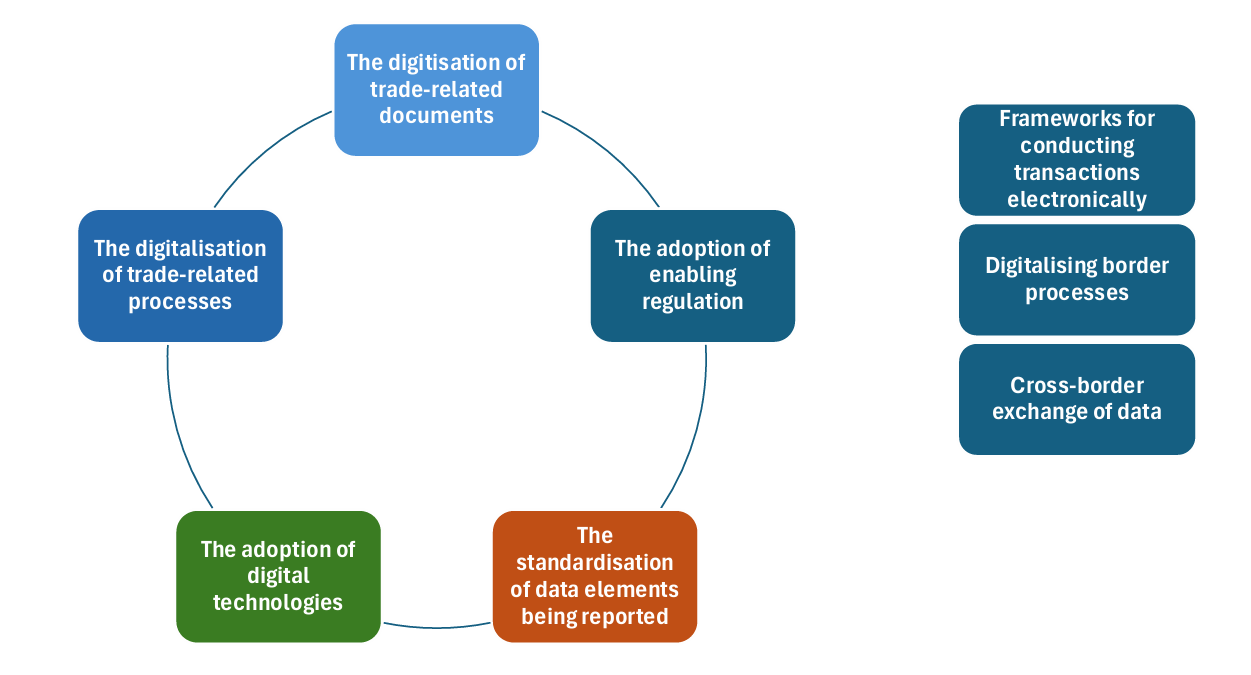
There are five building blocks to going paperless (Figure 1). Going paperless involves the: i) digitisation of trade documents (transitioning from physical to electronic trade documentation); ii) digitalisation of trade processes (streamlining and automating the procedural steps involved in international trade); iii) adoption of digital technologies (connecting documents and processes and enhancing efficiency and security); iv) standardisation of data elements (ensuring interoperability and consistency across systems); and v) implementation of enabling regulatory frameworks (establishing the necessary legal and institutional structures for paperless trade).
Figure 1. Going paperless: Five building blocks
There is progress in the regulatory environment underpinning the going paperless process, but this also faces a range of challenges that require further attention. OECD policy databases such as the Digital Services Trade Restrictiveness Index (DSTRI) and the Index of Digital Trade Integration and Openness (INDIGO) show that countries are moving quickly to adopt frameworks for electronic transactions. However, they reveal that progress has been slower in areas such as the legal frameworks for electronic transferable records and for domestic frameworks for e-payments. OECD Trade Facilitation Indicators (TFIs) highlight that trade facilitation tools at the border – such as pre-arrival processing and digital Single Windows for trade – have improved. In turn, digital tools required for border agency co operation (including shared risk management systems and interconnected computer systems) require further efforts. The regulatory environment for cross-border data exchange is also becoming more complex, posing challenges for seamless digital trade and the broader transition to a paperless ecosystem.
Why is this important?
Going paperless is important because it yields important trade cost reductions. Digitalising border processes significantly boosts trade across all sectors, especially when combined with streamlined procedures, simplified documentation, and enhanced co-operation among border agencies. A 10% global improvement in these areas, as measured by the TFIs, can lead to an 18% rise in global exports. The benefits of digitalisation are amplified when underlying trade processes are both streamlined and digitalised (Figure 2). Additionally, domestic regulatory reforms play a critical role. A 0.1-point reduction in the DSTRI - reflecting improved domestic frameworks for e-transactions, e-payments, and connectivity - is associated with a 37% increase in exports. This highlights the importance of enabling domestic digital environments alongside border process reforms. Finally, international co-operation is essential. As digital trade barriers grow, aligning global regulations on electronic transactions, data flows, and trust frameworks can further reduce frictions and support the broader transition to paperless trade.
Figure 2. Digitalising border processes and trade documents has an important effect on exports, with additional gains where documents and processes are streamlined
Impacts from a 10% improvement in the TFIs, by areas (%)
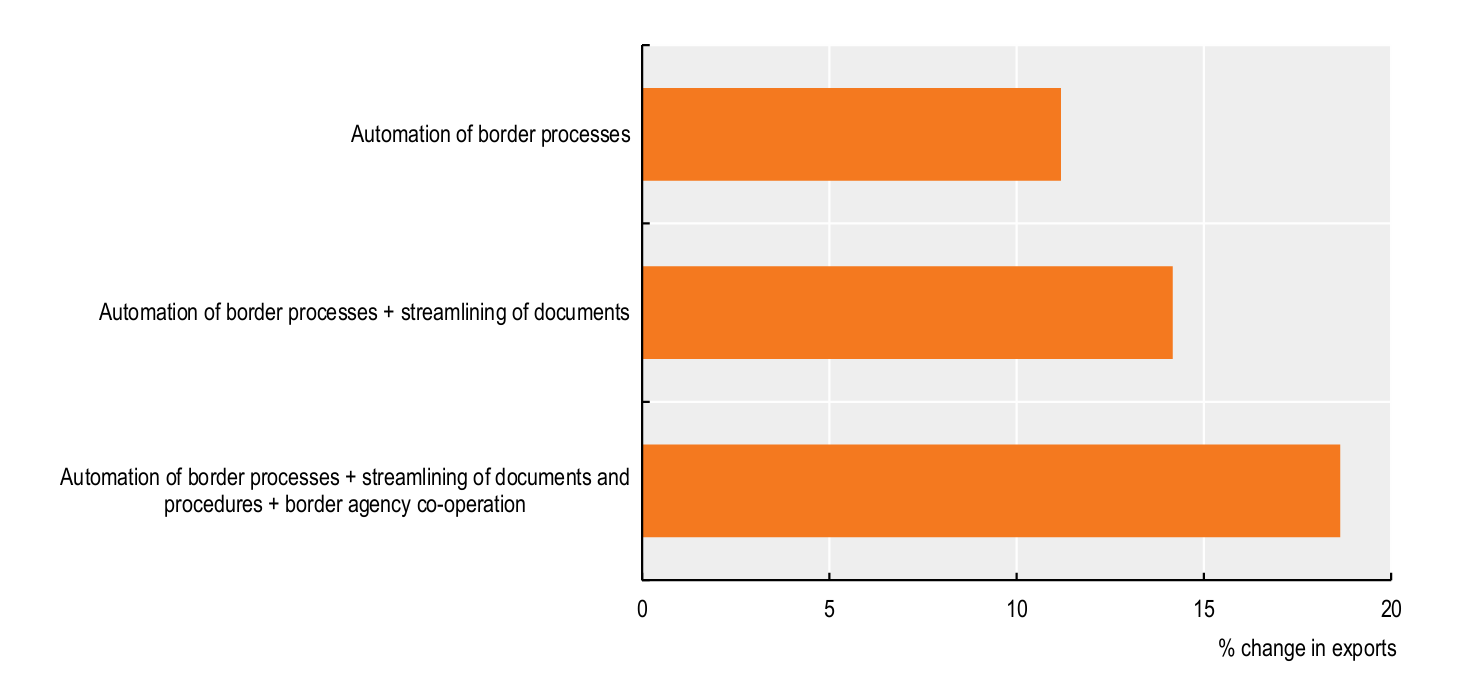
Note: The estimations control for border processes (as measured by the OECD TFIs), for domestic barriers to electronic transaction frameworks, e-payments and connectivity (as measured by the OECD DSTRI), as well as for the international trade-related discussions affecting digital trade (as captured through the OECD INDIGO).
Beyond trade costs, going paperless is a critical enabler of broader policy objectives. For customs and regulatory authorities, digital processes allow for faster checks, improved enforcement, and reduced delays at the border. It can strengthen supply chain resilience and visibility – which are critical considering recent global disruptions such as the COVID-19 pandemic, geopolitical tensions, and natural disasters – by enabling real-time tracking and data exchange. For instance, in the agri-food sector, during the COVID 19 pandemic, electronic certificates for Sanitary and Phytosanitary requirements helped prevent a 33% drop in trade value in the meat processing sector, which would have otherwise occurred (Laget and Deuss, 2025[1]). Going paperless also supports better firm-level risk management, allowing firms to identify vulnerabilities and diversify operations.
Digital solutions can also help businesses meet new environmental and social sustainability requirements more effectively. However, there are still important gaps in clarifying what compliance entails for border processes and for integration in a paperless trade ecosystem. While two-thirds of surveyed social and environmental-related regulations specify border processes, only half define documentary requirements (e.g. documents of conformity, supply chain audits) and around one-quarter specify the requirements for platforms underpinning the exchange of information. Mechanisms for border agency co-operation are rarely covered.
What does this mean for trade policy?
• All building blocks for going paperless need to advance in parallel. Advancing on one without another can create bottlenecks that reduce effectiveness. For example, private and public sector adoption of digital documents and processes will only be effective if appropriate technologies are being used to share data, including with customs and border authorities, and if regulatory frameworks are adapted to the use of digital certificates.
• There is a significant leap in the value of digitalisation when border processes are also streamlined. There is also a strong case for domestic regulatory reform to enhance the effects of going paperless on export competitiveness. The international regulatory landscape in areas that support electronic transactions, trust, and cross-border data flows also matters, given the important role of international co-operation in reducing frictions from regulatory differences. Against a backdrop of growing domestic barriers to digital trade, engagement in international regulatory co-operation on digital trade-related issues can also help advance the areas that underpin going paperless.
• The going paperless policy environment has an important role to play in supporting technical interoperability when implementing or managing sustainability-related requirements and can help minimise transaction costs. There is a need for countries that are implementing sustainability-related requirements to clarify for traders and border officials the role of documentary requirements; of data platforms and cross-border exchange of information; of border formalities and procedures; and of border agency co-operation mechanisms.
Further information
Read the full report: OECD (2025), “The digitalisation of trade documents and processes – Going paperless today, going paperless tomorrow”, OECD Trade Policy Papers, N°297, OECD Publishing, Paris, https://doi.org/10.1787/64872f25-en.
References
Laget, E. and A. Deuss (2025), “Sanitary And Phytosanitary Electronic Certificates: Current Practices and Benefits”, OECD Food, Agriculture and Fisheries Papers, No. 219, OECD Publishing, Paris, https://doi.org/10.1787/1a5fd2e0-en.