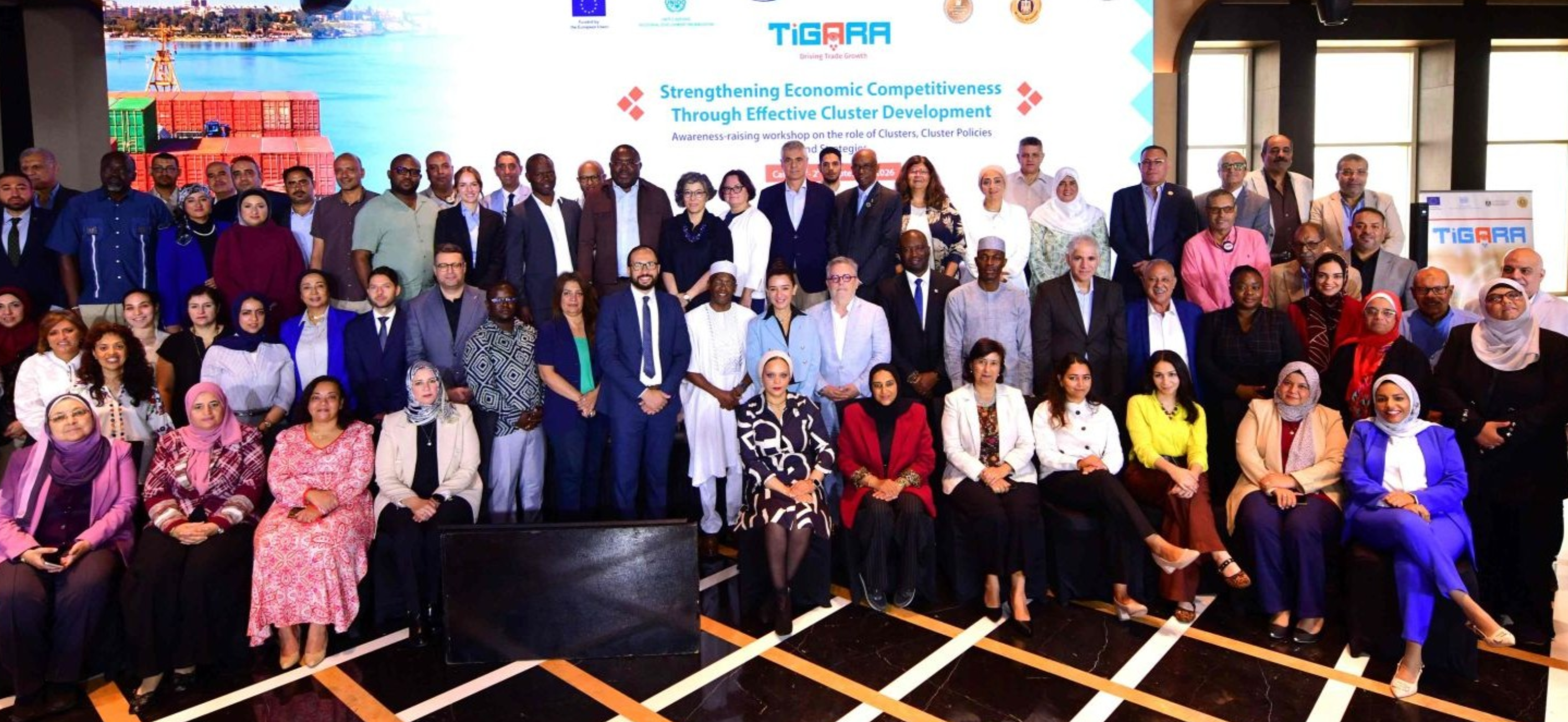
Cairo, Egypt, 2 September 2026 – The United Nations Industrial Development Organization (UNIDO) convened a workshop for government representatives, Regional Economic Communities, private-sector actors and international experts in Cairo on 1–2 September to explore how industrial clusters can help SMEs strengthen value-chain linkages, boost competitiveness and access regional market opportunities.
The meeting was organized under the European Union-funded Trade, Industry, Growth and Rapid Market Access (TIGARA) Egypt project and the Economic Community of Central African States (ECCAS) component of the Africa Trade Competitiveness and Market Access (ATCMA) Programme. Bringing these two initiatives together created an opportunity to connect practical experience from cluster development in Egypt with a wider regional exchange on how clusters can strengthen value chains, enterprise competitiveness and market access across Africa.
Industrial clusters – geographic concentrations of interconnected firms and institutions – have long been used to help firms benefit from proximity, shared services, specialized skills and closer links with institutions and markets. For SMEs in particular, these relationships can improve access to knowledge and technology, strengthen product quality, and create opportunities that individual firms may struggle to pursue alone.
In Egypt, UNIDO is applying this approach through four clusters supported by TIGARA. The project is working with enterprises and institutions on cluster governance, product quality, circular economy practices, skills and technology, and access to domestic and international markets.
The Cairo workshop brought this experience - and UNIDO’s wider expertise in cluster development - into a broader African discussion.
“For UNIDO, cluster development is more than an economic tool. It is a catalyst for creating jobs, strengthening local value chains, empowering women and youth, and building resilient industrial ecosystems that can compete in regional and global markets,” said Ebe Muschialli, Industrial Development Officer at UNIDO.
“True economic clusters are not created by design alone. They emerge when competing firms operate close enough to learn from one another, absorb better ideas and practices, and ultimately collaborate where shared strength allows them to compete more effectively in global markets,” noted Ahmed Maghawry Diab, Assistant Minister and Head of the Developmental Projects Unit at Egypt’s Ministry of Industry.
Representatives of the Economic Community of West African States (ECOWAS), Common Market for Eastern and Southern Africa (COMESA), Southern African Development Community (SADC), Economic Community of Central African States (ECCAS) and the Comoros shared the status of cluster development in their respective regions, alongside the challenges involved in coordinating industries and value chains across borders.
Their contributions placed cluster development firmly within Africa’s wider regional integration agenda. Under the African Continental Free Trade Area (AfCFTA), improved access to regional markets creates new opportunities for African enterprises.
This is where the work of ATCMA is particularly relevant. The programme brings together UNIDO expertise across areas that directly affect the ability of enterprises to compete, from quality infrastructure and standards to SME development, value chains and market access.
The regional discussions also explored the potential of cross-border clusters, with African countries working to translate the promise of the AfCFTA into greater production and trade across the region.
The Cairo workshop helped translate these discussions into the next practical steps, connecting lessons from cluster development at the country level with regional institutions and programmes working to strengthen competitiveness across Africa.
Through TIGARA and ATCMA, UNIDO and the European Union will continue that work at national and regional levels, using cluster development to strengthen SMEs, build more connected value chains, and expand opportunities for African enterprises to compete across markets.
For more information, please contact:
Industrial Development Officer