As geopolitical tensions, economic security concerns and changing supply chains reshape international investment, developing economies are adapting their policies to attract investments and strengthen their contribution to development.
© UNCTAD Photo | Acting Secretary-General Moreno (pictured right) opens the 16th Investment, Enterprise and Development Commission on 31 August in Geneva. The meeting hears, among others, from Bangladesh and Tunisia on how they are adapting their investment strategies to position themselves more effectively in a rapidly changing global landscape.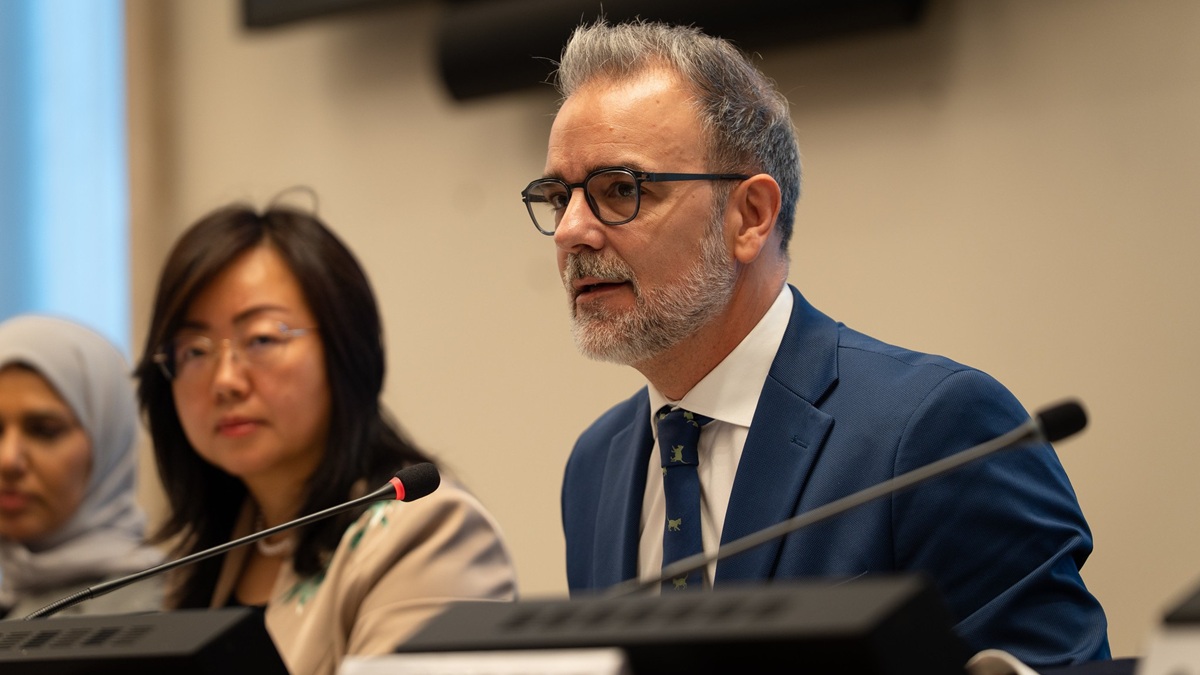
Global foreign direct investment (FDI) rose 6% to $1.6 trillion in 2025, but the recovery remained fragile and concentrated. Developing economies recorded growth of just 2%, while the top 20 host economies attracted more than 80% of global flows.
Investment is also shifting towards strategic sectors. Artificial intelligence infrastructure, semiconductors, critical minerals and energy-transition technologies accounted for 44% of announced greenfield project value in 2025, up from 16% in 2020. Low and lower-middle-income economies attracted only around 10% of investment in these sectors between 2020 and 2025.
Nan Li Collins, Director of the Division on Investment and Enterprise at UN Trade and Development (UNCTAD) stressed that: “…investment is recovering, but its benefits remain concentrated and many developing economies risk missing strategic opportunities.”
Investment decisions are becoming more strategic
Geopolitical tensions, trade uncertainty and economic security concerns are changing how firms and governments make investment decisions.
Companies still consider costs, but are placing more weight on predictability, market access and supply-chain risks. Governments are using industrial policies, incentives and investment screening more actively.
UNCTAD recorded 229 national investment policy measures adopted in 2025. Most were favourable to investors, but increasingly targeted priority industries. Meanwhile, the number of economies screening FDI on national security grounds has doubled since 2019.
The World Investment Report 2026 says developing economies need realistic entry points in changing value chains, supported by infrastructure, reliable energy, skills, investment facilitation, supplier development and regional connectivity. It also points to the need for closer coordination across investment, industrial, trade and technology policies.
The experiences of Tunisia and Bangladesh illustrate how investment policy reform can respond to some of these challenges.
Tunisia: Streamlining processes and improving the investment climate
UNCTAD’s 2025 Investment Policy Review of Tunisia identifies administrative complexity, limited digitalization, legal ambiguity and restrictive policies among barriers to investment and more equitable regional development.
Its recommendations focus on simpler procedures, digitalization, stronger institutional coordination and mobilizing domestic, foreign and diaspora investment. Current reforms to the investment law and institutional framework address several of these areas.
Jalel Tebib, Director General of the Foreign Investment Promotion Agency of Tunisia and Acting Director General of the Tunisia Investment Authority, said: “I believe the new investment law is an answer to these demands, and we are practically in the final stage of drafting it […] with the simplification of procedures, the clarification of several concepts and the establishment of a new governance framework for investment.”
Bangladesh: From policy recommendations to implementation
In Bangladesh, a 2026 assessment report finds progress since the country’s 2013 UNCTAD Investment Policy Review through regulatory and institutional reforms, digital platforms and stronger investment promotion.
It also identifies unfinished priorities: a national investment policy, consolidated investment law, complete digital procedures, better infrastructure and skills, as well as stronger links between foreign investors and domestic firms.
Nahian Rahman Rochi, Executive Member of the Bangladesh Investment Development Authority, highlighted that “In 2025, we were able to complete 25 out of the 32 reforms that we promised to do. […] This was all made transparent and public to the investors, which actually increased and enhanced their confidence in Bangladesh.”
From attracting investment to strengthening development impact
The changing investment landscape places greater emphasis not only on how much capital countries attract, but on where it goes and what it contributes to their economies.
FDI remains an important source of external finance for developing economies, but its development impact depends on whether it contributes to productive capacity, jobs, skills and technology transfer.
The experiences of Tunisia and Bangladesh also show that investment policy reform is not a one-off exercise. Identifying constraints is only one part of the process. Implementation, institutional capacity, coordination and continued engagement are essential to translate recommendations into tangible reforms.
The example from the two countries shows that identifying constraints is only the beginning. Implementation, institutional capacity and coordination determine whether reforms translate into investment – and whether that investment builds productive capacity, jobs, skills and technology.
Greater concentration in strategic sectors increases the risk that developing economies will be left behind. But changing supply chains can also create openings for countries that strengthen their institutions and productive capabilities. The objective is not simply to attract capital, but to direct it towards diversification and long-term development.
These issues will be further explored at UNCTAD’s World Investment Forum 2026, from 25 to 27 October in Doha, Qatar.