It is with deep sadness that we have learned of the passing of Professor Ben van der Genugten, Professor Emeritus of Probability Theory and Mathematical Statistics at Tilburg University. Ben passed away on July 15 at the age of 82.
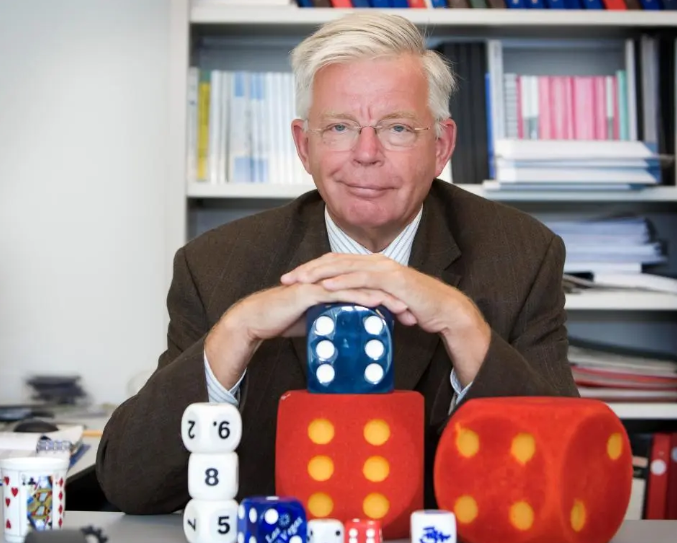
Ben van der Genugten was born on September 23, 1943, in Enschede. He studied Mathematics and Physics at the University of Groningen, specializing in Probability Theory and Statistics. In 1969, he earned his PhD with highest honors under the supervision of Professor A.J. Stam, defending his dissertation The Random Walk with Stochastic Sojourn Times. After several years with the Statistics Group at Philips in Eindhoven, he was appointed Associate Professor of Probability Theory and Mathematical Statistics at the then Tilburg Catholic Academy in 1972. He was promoted to Full Professor in 1975. Ben remained affiliated with our university for more than 36 years, until his retirement in 2008.
Ben was a statistician for whom theory and application were inseparable. His research focused primarily on regression analysis and game theory. In addition to his scholarly publications, he wrote an introductory textbook in statistics and contributed to several books intended for a broader audience. In his teaching, he emphasized the importance of model-based thinking. Before performing any calculations, students first had to carefully examine the problem, the underlying assumptions, and the way in which the data had been generated. Through concrete examples, ranging from rolling dice to casino games, he made abstract statistical concepts accessible and engaging.
A particularly distinctive and socially relevant aspect of Ben's work was his research on the distinction between games of chance and games of skill. Together with colleagues, he developed a quantitative method for measuring the degree of skill involved in games. The method compared the effects of learning and strategic decision making with the influence of chance. It was applied to, among other things, Golden Ten, blackjack, internet management games, and poker.
These studies extended well beyond academia. Ben conducted extensive contract research in support of the consistent application of the Dutch Betting and Gaming Act (Wet op de Kansspelen) and frequently served as an expert witness in legal proceedings. Through his analyses, he made important contributions to the legal and public debate on when players can genuinely exert a predominant influence on the outcome of a game. Based on his research, he argued that poker is, to a significant extent, a game of skill.
In addition to his work as a researcher and lecturer, Ben made significant contributions to the governance of the university. He served as Dean of the then Sub-Faculty of Econometrics, was a member of the Council of Deans, served on the Board of the Faculty of Economics, and chaired the Department of Econometrics. Outside the university, he served on the board of the Netherlands Society for Statistics and Operations Research and was Editor-in-Chief of Statistica Neerlandica.
In his farewell lecture, Les jeux sont faits, Ben reflected with great appreciation on the colleagues with whom he had worked and on the shared responsibility for education, research, and academic leadership. The lecture reflected his intellectual curiosity, his sense of perspective, and his enjoyment of collaboration. He felt a deep connection to Econometrics and to the university, which during his career successively bore the names of Tilburg Catholic Academy and Tilburg University.
With the passing of Ben van der Genugten, we have lost a distinguished scholar, a dedicated lecturer and academic leader, and a valued colleague who combined fundamental statistical insights with pressing societal questions. His work at the intersection of probability theory, game theory, and the law will continue to have a lasting impact.
We remember Ben with deep respect and great appreciation. Our heartfelt condolences go to his family, friends, and loved ones. We wish them strength and comfort as they cope with this profound loss.
On behalf of the Executive Board and Tilburg School of Economics and Management