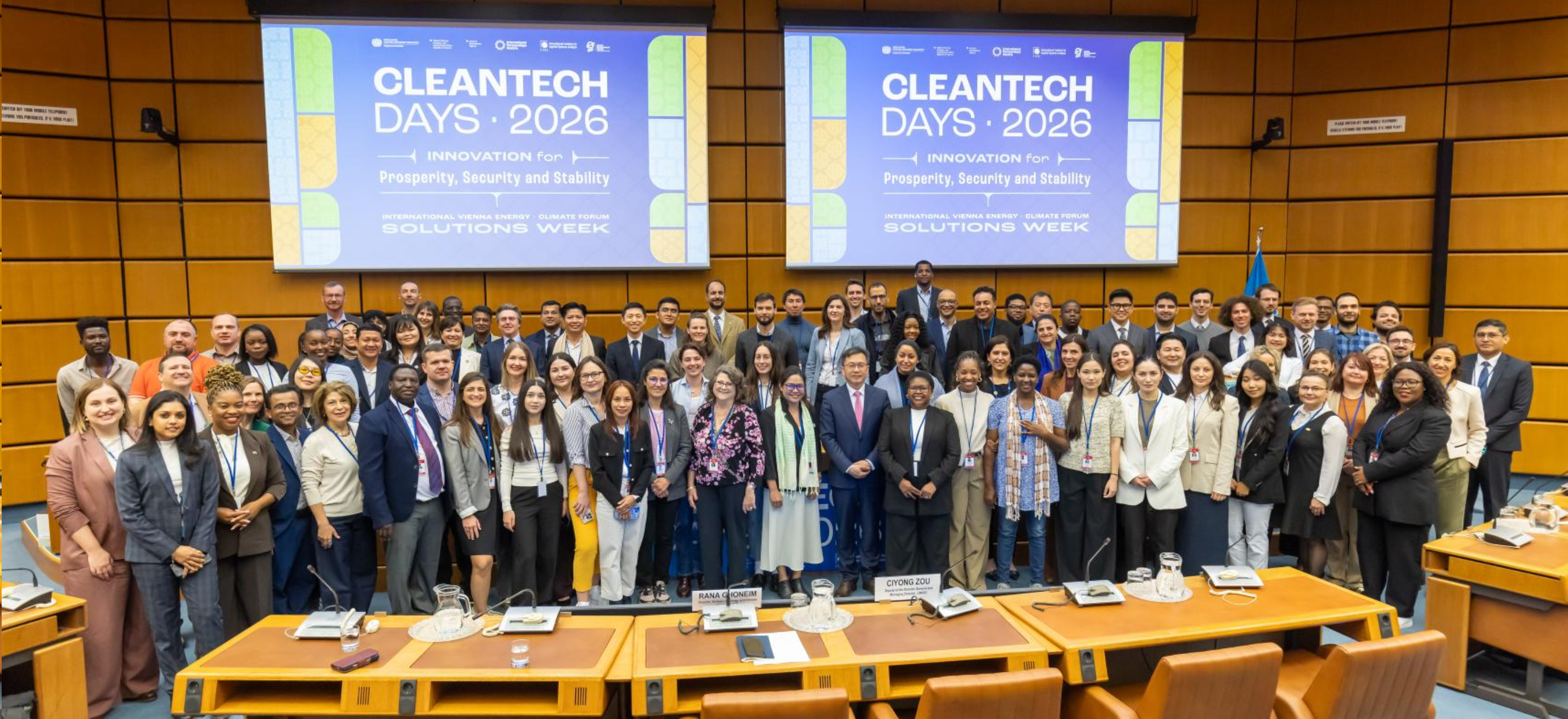
Vienna, Austria, 16 April 2026 – The United Nations Industrial Development Organization (UNIDO) convened the Cleantech Days 2026, the Global Cleantech Innovation Programme’s (GCIP) annual forum, funded by the Global Environment Facility. Running from 7 to 10 April 2026, in conjunction with International Vienna Energy and Climate Forum, the event brought together cleantech entrepreneurs, policymakers, investors and industry leaders under the theme Innovation for Prosperity, Stability and Security.
The four-day forum underscored a growing global consensus: cleantech innovation is not simply an environmental priority, but a strategic response to energy security, industrial decarbonization and supply chain resilience. In a world facing overlapping crises, from climate disruption and resource insecurity to political instability, cleantech innovation has emerged as a practical and scalable pathway to strengthen national economies, create green jobs and rebuild communities.
“Clean technology and entrepreneurship are increasingly recognized not only as tools for climate action, but as strategic pillars for national resilience, economic competitiveness and long-term prosperity. Sustainable energy and climate-resilient technologies are not optional but rather imperative. Cleantech innovation can support recovery, create livelihoods, and build resilience in communities most affected by instability,” said Ciyong Zou, Deputy to the Director General and Managing Director of
From ideas to impact: GCIP’s growing footprint
Since the relaunch of the second phase of the programme, GCIP has supported more than 700 cleantech ventures across 12 countries, accelerating startups and small and medium-sized enterprises working on solutions across renewable energy, energy efficiency, green construction and transportation, waste management and advanced chemicals and materials. Cumulative data from the eight GCIP countries confirms that over 9,000 green jobs were created and nearly USD$32 million in investment was raised by GCIP-supported entrepreneurs.
This year’s edition drew entrepreneurs from nine GCIP countries, Cambodia, Kazakhstan, the Republic of Moldova, Morocco, Namibia, Senegal, South Africa, Türkiye and Ukraine, alongside
international partners, corporate actors, climate finance representatives, peer innovators and multilateral institutions. More than 120 participants convened across the four-day programme.
A four-day programme built around action
Cleantech Days 2026 opened with discussions on two key drivers of green industrial transformation: the use of artificial intelligence and digital tools to accelerate cleantech innovation, and inclusion as a core industrial strategy, highlighting the role of women, youth and migrant entrepreneurs in the green transition. The second day focused on peer learning, with founders and GCIP country teams sharing experiences, and featured a joint dialogue under the Gender and Energy Compact on building inclusive cleantech entrepreneurship ecosystems for a just energy transition.
On 9–10 April, participants attended the IVECF at Hofburg Palace, culminating in the Global Pitching Competition. Twenty GCIP-supported teams pitched their solutions on 9 April, with six finalists advancing to present again to IVECF audiences on 10 April. The following awards ceremony recognized the top performers and global winners in these categories:
- Overall Top Performer – Emerging Startup: Helios (Türkiye)
- Overall Top Performer – Growth-Stage Startup: Eco Diamba Ndaye (Senegal)
- Special Mention – Gender Impact: Anon (Cambodia)
- Special Mention – Youth Leadership: HydroTech ATM (Kazakhstan)
- Special Mention – GHG Mitigation Potential: Sirocco Energy (Ukraine)
- Special Mention – Social Impact: Phoka M Holdings (South Africa)
In addition, the GCIP Legacy Award recognized outstanding individual contributions to the programme advocacy and visibility, with the 2026 award presented to Rita Idehai, Founder of Ecobarter (Nigeria).
Inclusion at the centre of the green transition
Cleantech Days 2026 placed particular emphasis on women, youth and migrants as key drivers of innovation, framing inclusion as a prerequisite for competitive, resilient and just green economies. Dedicated sessions addressed the financing gap in underserved markets, convening investors, blended finance experts and policymakers to explore how inclusive cleantech ecosystems can be designed, financed and scaled to support a truly just transition.
“A successful energy transition depends not only on technology readiness, but on ecosystem readiness. If innovation systems, financing mechanisms, and procurement frameworks are not intentionally designed to include women and underserved entrepreneurs, we limit both the speed and the impact of cleantech deployment. Inclusion is no longer a social add-on, but it is a structural requirement for scaling clean energy solutions,” said Manasa Suresh, Associate Industrial Development Expert, and Programme Manager of GCIP, UNIDO.
For more information, please contact:
Associate Industrial Development Expert, UNIDO