Cities across low‑ and middle‑income countries (LMICs) are turning to solar power at a pace that would have seemed far‑fetched not long ago. As panel prices tumble and electricity demand rises in fast‑growing urban centres, solar is slipping into the fabric of everyday life: from the rooftops of Nairobi and Dhaka to the industrial fringes of São Paulo.
IRENA data show LMICs added more than 100 GW of new solar capacity in 2023 alone, pushing their share of global solar PV above 40%, roughly double what it was a decade ago. In many cities, this expansion is already transforming urban energy systems, from the spread of rooftop arrays on homes and small businesses to municipal governments extending solar to street lighting, water pumping, metro systems and public buildings.
Running out of space for solar
But in many fast‑growing LMIC cities, the rise of solar runs up against a simple physical limit: there is barely any space left for large‑scale installations. Rapid population growth, dense informal settlements and competing demands for land mean that large‑scale solar farms are often pushed to the urban fringes or ruled out entirely. Within cities, rooftops are frequently too small, too shaded or structurally unsuitable for large areas of solar panels, while commercial and industrial zones are already crowded with competing uses. As a result, cities that urgently need new clean power often struggle to find the room to install it.
Turning to water when land runs short
The space crunch is forcing city planners to look beyond the usual options and, increasingly, their attention is turning to the reservoirs, natural lakes and pit lakes (former sand and gravel pits) which offer vast, under‑used surfaces that can host floating solar arrays without competing for land. Not every water body is suitable, but where conditions allow, floating solar offers a rare opportunity to scale solar without displacing people or industry. For cities boxed in by growth, floating solar offers a way to expand clean power generation without displacing homes, industry or green spaces, or without waiting years for new land to be acquired or cleared.
How floating solar works
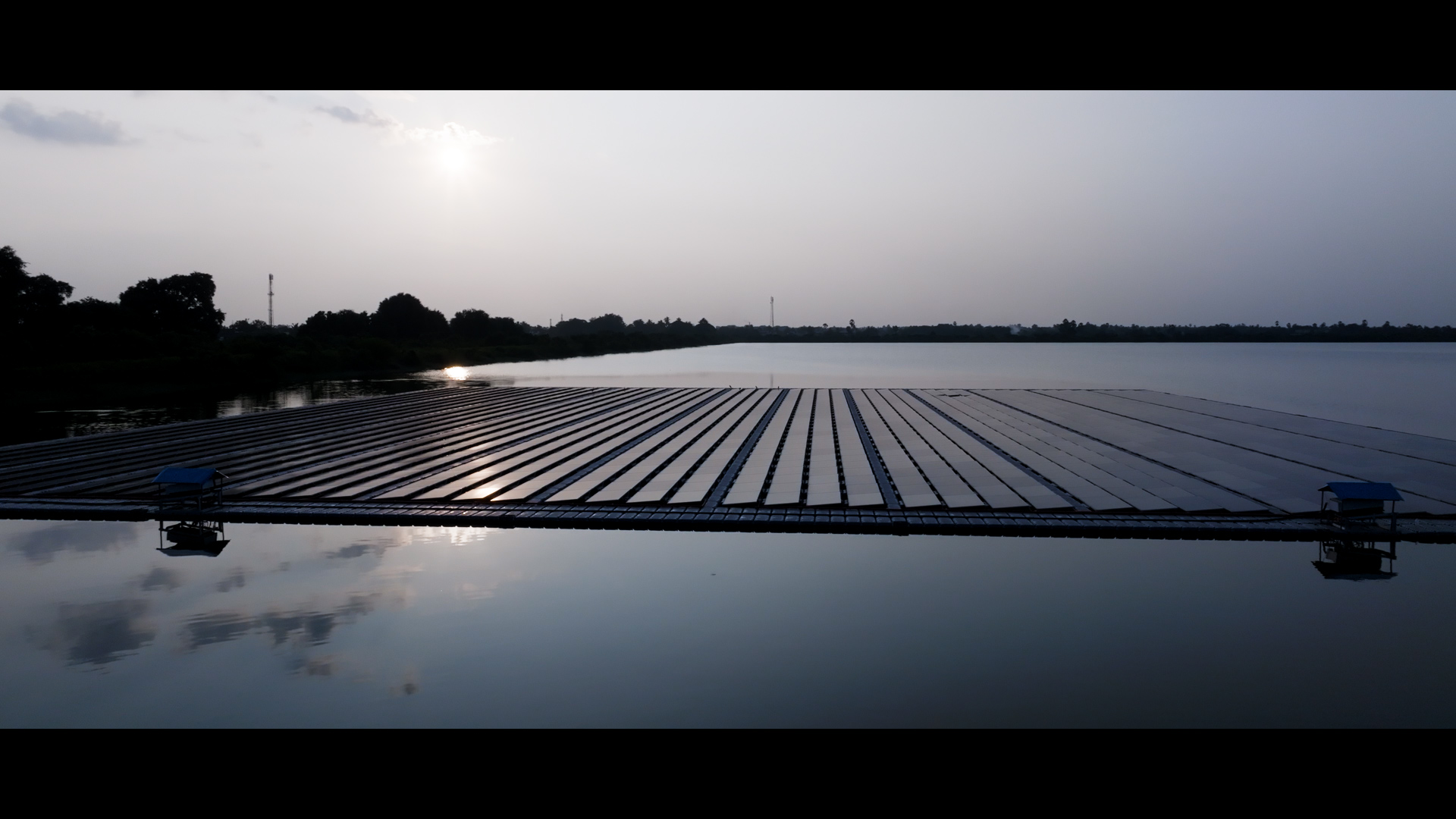
Floating solar (known as floating photovoltaic or FPV) refers to solar PV systems mounted on buoyant structures that are deployed on the surface of water bodies where the panels, anchoring systems and electrical components are designed to withstand hydrodynamic forces, fluctuating water levels and long‑term exposure to moisture. Mooring systems allow the platforms to rise and fall with seasonal changes, ensuring stable operation even in variable conditions.
FPV is relevant for city decarbonization because it unlocks underutilized water surfaces and reduces land-use conflicts. It is an especially useful option in cities where rooftop deployment faces technical, regulatory, or ownership barriers. FPV turns previously untapped municipal assets into clean‑energy infrastructure.
Cooler panels, higher output, saving water
It has other advantages too. Solar panels lose efficiency as they heat up, but water naturally cools floating systems, boosting output by 5-15% compared with rooftop or ground‑mounted installations. With the panels sitting just above the water surface, heat is drawn away through constant evaporative and convective cooling, keeping panel temperatures lower throughout the day.
By shading the water surface, FPV can also significantly reduce evaporation losses – a meaningful gain in water‑stressed regions where every saved litre supports drinking water, irrigation or industry.
Grid proximity and infrastructure synergy
In addition, many urban water bodies sit close to existing infrastructure – treatment plants, substations, pumping stations – which cuts transmission losses and lowers integration costs. And when FPV is paired with hydropower, the two can operate as a hybrid system, smoothing output and strengthening grid stability.
Floating solar isn’t a replacement for rooftop systems; it’s a way for cities to unlock new space, strengthen their grids and accelerate decarbonization when land is scarce, offering a practical route to keep expanding clean energy even as pressures on urban space intensify.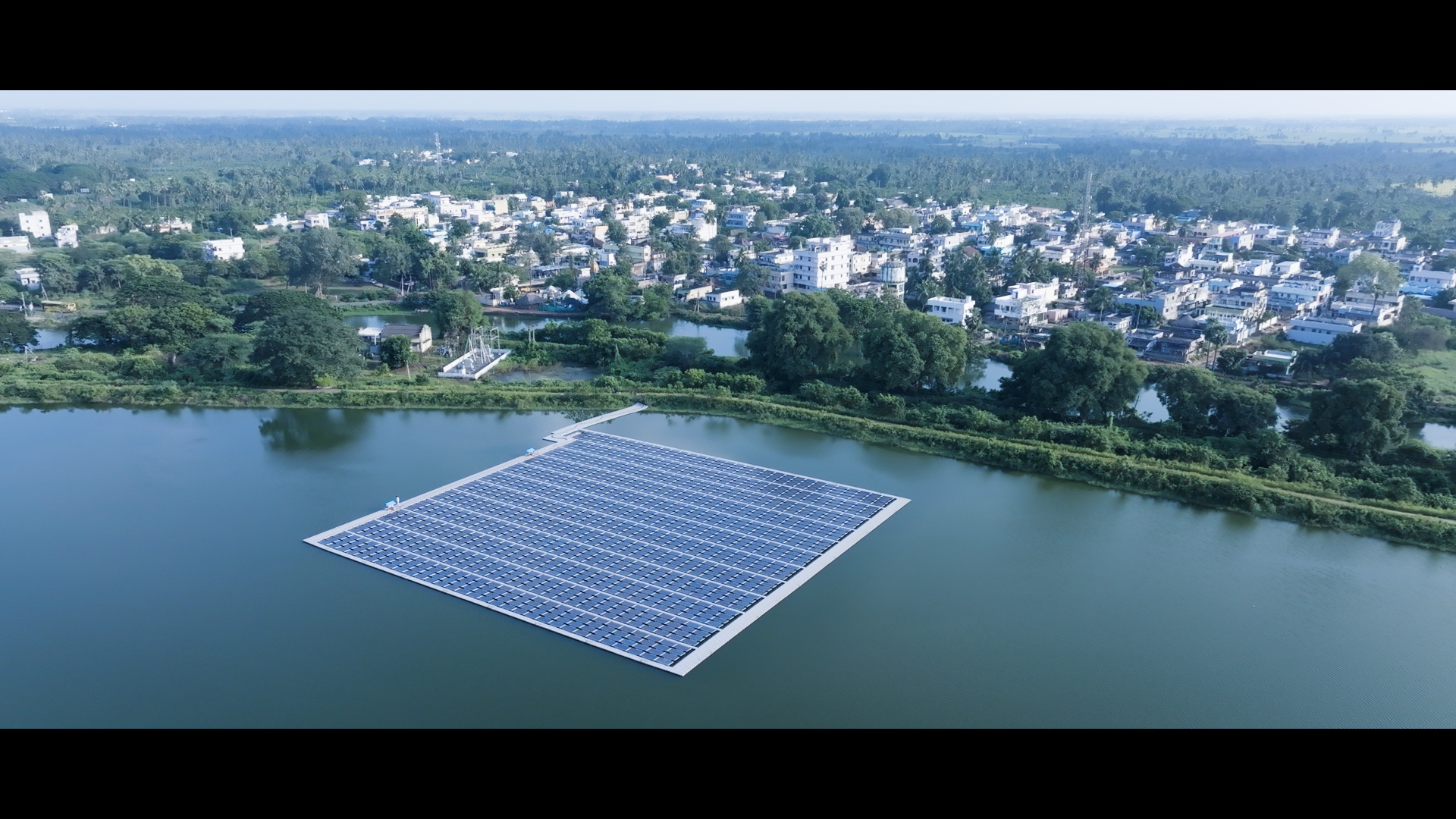
The 500 kWp floating solar power plant on the Sangam Jagarlamudi Reservoir near Guntur, Andhra Pradesh, designed and installed by Quant Solar, an India‑based engineering company contracted by the Guntur Municipal Corporation. (Photo: UNIDO)
A UNIDO initiative in Guntur, a city in the Indian state of Andhra Pradesh, includes a 500 kWp FPV plant on the Sangam Jagarlamudi Reservoir. The installation is part of a Global Environment Facility (GEF)-funded project demonstrating a holistic approach to the decarbonization of cities and communities.
The FPV system, which occupies about 1,500 square metres of the reservoir, produces roughly 750 MWh of clean electricity each year. Feeding this power into the local grid allows the plant to offset the electricity used to charge the city’s new fleet of 220 battery-electric three‑wheelers for waste collection.
Their introduction enabled the Guntur Municipal Corporation to retire the diesel‑powered trucks that had handled most door‑to‑door waste collection. By displacing an estimated 59,300 litres of diesel every month, the switch is expected to cut around 19,000 tonnes of CO₂ emissions over the next decade, delivering both climate and air‑quality benefits for the city.
The new vehicles can access alleys and lanes that the larger diesel trucks could not reach and, as a result, door-to-door waste collection has increased from 60% to 95%. Much of this waste is organic and, now segregated from other streams, is being turned into compost, reducing the methane emissions that would otherwise be generated if the material had gone to landfill or been incinerated.
The FPV plant generates more than 2.3 times the energy needed by the new electric vehicle fleet. Its output is fed into the local grid, offsetting municipal electricity use across services such as street lighting and administrative buildings, and reducing reliance on fossil‑fuel‑based grid power.
By shading the reservoir surface, the installation also reduces evaporation – an estimated 2,250 litres of water saved each day, or more than 800,000 litres a year – offering an additional resource benefit in a region where water management is increasingly important. While Guntur is not among India’s most water‑stressed cities, it sits in a semi‑arid region where rainfall is highly seasonal and reservoirs play a central role in municipal supply.
For other Indian cities with suitable areas of water and municipal energy demands, the project in Guntur offers a replicable model for low‑carbon urban services, illustrating how progress accelerates when climate goals, municipal operations and industrial development are treated as a connected nexus rather than as separate agendas.