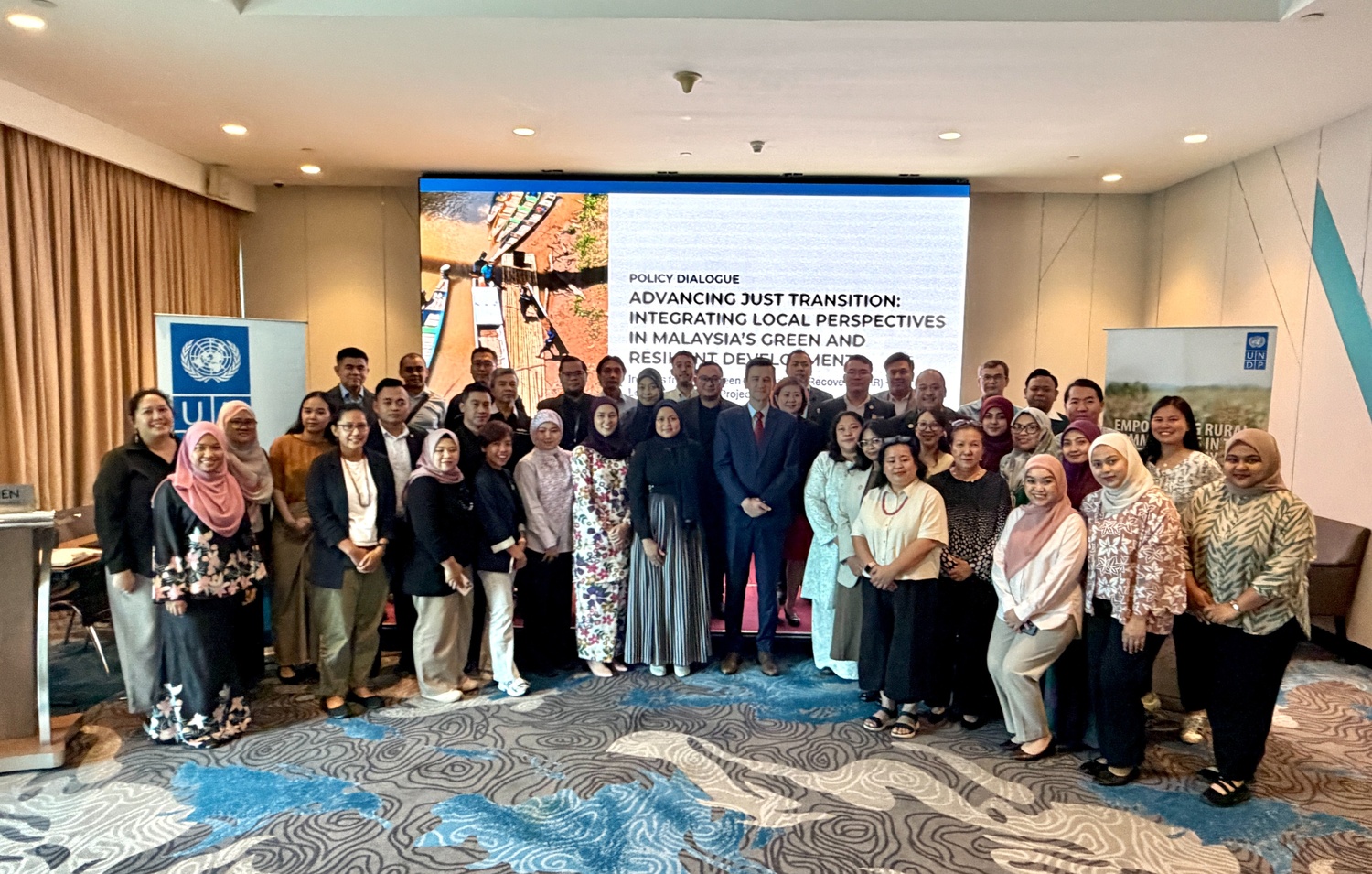
 Policy Dialogue Advancing Just Transition: Integrating Local Perspectives in Malaysia's Green and Resilient Development
Malaysia’s shift toward a low-carbon future is gaining pace, but a crucial question remains: who stands to benefit, and in what ways? In December 2025, this question set the tone for a Policy Dialogue on Just Transition convened by UNDP Malaysia, Singapore, and Brunei Darussalam. The dialogue brought together Malaysian government representatives, civil society organisations, and private sector partners to examine how climate action can be both environmentally ambitious and socially just.
The dialogue moved beyond national targets and megawatts. Instead, it centred on people, especially communities in rural and remote areas, where access to reliable energy can shape livelihoods, local economies, and long-term resilience. Participants explored how clean energy solutions, when designed with communities rather than for them, can unlock sustainable livelihoods, support MSME growth, and strengthen local ownership of development pathways.
A key highlight of the dialogue was the Green and Resilient Recovery (GRR) Local Action Grant project, which offered tangible proof that locally grounded solutions can deliver meaningful change. Across 16 villages in Pahang, Sabah, and Sarawak, solar photovoltaic and micro-hydro mini systems have improved energy access for more than 1,300 community members. For many villages, this has meant more than just lights staying on. It has enabled small businesses to operate, reduced dependence on costly and unreliable energy sources, and created new opportunities for income generation.
Crucially, the project paired infrastructure with people-centred investments. Community members received technical training, entrepreneurial support, and hands-on experience managing energy systems, helping to ensure that solutions remain operational, financially viable, and locally owned. These experiences underscored a key lesson echoed throughout the dialogue: technology alone is not enough. Capacity, trust, and local leadership are equally essential.
These insights were further explored during a panel discussion featuring Adrian Lasimbang, Technical Director of TONIBUNG; Dr Janie Liew, Executive Director of Good Shepherd Services; and Nizam Rahman, environmental activist and project coordinator from KUASA, moderated by Dr Cheah, Head of Governance and Local Development of UNDP Malaysia. Panelists shared on-the-ground perspectives, highlighting persistent challenges such as intermittent energy supply, connectivity gaps, and the difficulties of sustaining off-grid systems without long-term policy and financial support.

Left to right: Dr Jessie Cheah, Head of Governance and Local Development UNDP Malaysia; Adrian Lasimbang, Technical Director TONIBUNG; Dr Janie Liew, Executive Director Good Shepherd Services and Nizam Rahman, Project Coordinator and Environment Activist KUASA.
Discussions also pointed to a broader challenge, ensuring that national and subnational policies are sufficiently flexible to respond to Malaysia’s diverse local contexts. Participants stressed that off-grid and community-based energy solutions must be recognised not as temporary fixes, but as integral components of the country’s energy and development ecosystem.
Key Recommendations from the Dialogue
Several priority actions emerged from the dialogue to advance a just transition that is inclusive, resilient, and locally grounded.
Strengthen policy alignment and inclusivity
Voices from the ground such as on ground partners and communities emphasised the need for closer coordination between national, state, and local policies to ensure that clean energy and low-carbon initiatives reach underserved communities. Policies should explicitly recognise off-grid and community-owned energy systems, align funding mechanisms across levels of government, and incorporate social and livelihood outcomes alongside climate and energy targets.
Embed community engagement throughout the project lifecycle
A just transition requires communities to be active partners, not passive recipients. The dialogue highlighted the importance of participatory planning, where communities help identify energy needs, select appropriate technologies, and define governance models. Early and continuous engagement was seen as critical to building trust, strengthening ownership, and ensuring long-term sustainability.
Invest in capacity-building and long-term technical support
Beyond infrastructure, participants called for sustained investments in local technical, entrepreneurial, and financial skills. This includes training community technicians, supporting local enterprises linked to energy access, and establishing mechanisms for ongoing maintenance and troubleshooting. Such investments help communities manage systems independently and adapt to future challenges.
Foster cross-sector collaboration to scale impact
Scaling community-based energy solutions will require stronger partnerships between government agencies, private sector actors, financial institutions, and civil society organisations. Participants highlighted the value of blended financing, shared risk models, and public, private, and community partnerships to ensure financial viability, operational sustainability, and wider replication of successful models.
Strengthen knowledge sharing and learning ecosystems
The dialogue underscored the importance of systematically capturing lessons from local projects and feeding them back into policy design. Creating platforms for knowledge exchange across communities, states, and sectors can help refine approaches, avoid duplication, and accelerate learning for future programmes.
Looking Ahead
The Policy Dialogue reinforced a powerful message: Malaysia’s just transition will succeed only if it is rooted in local realities, guided by inclusive policies, and supported by strong partnerships. By aligning climate ambitions with community priorities and livelihood needs, the country can build development pathways that are not only low-carbon, but also resilient and equitable.
A forthcoming policy brief will distil the dialogue’s key insights and translate on-the-ground experiences into practical recommendations for policymakers and practitioners. It will offer a closer look at what it takes to scale community-led energy solutions and embed local perspectives into Malaysia’s just transition.
To stay informed and be the first to receive updates, subscribe to UNDP Malaysia’s newsletter at https://www.undp.org/malaysia/contact-us and follow the next steps in shaping a greener, more inclusive future for all.