Together with an international research team, WU Professor Baris Pascal Güntürkün from the Department of Marketing analyzed data from 24 countries over a 25-year observation period. Six of these countries switched from an opt-in to an opt-out system during that time, including England and the Netherlands. The findings show that while the number of postmortem organ donations increased by only about 7 percent on average, living donations declined by 29 percent. “Across all countries that switched to an opt-out system, the regulation thus led to an overall decline in donations,” says Güntürkün. What’s more, postmortem donations are not a direct substitute for living donations. While deceased donors can provide multiple organs, living donations – such as kidneys – tend to result in better medical outcomes and higher survival rates for recipients.
Opt-out systems can have unintended psychological effects
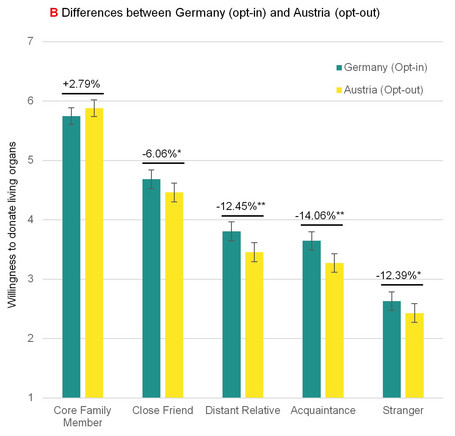
A comparative survey between Germany (opt-in system) and Austria (opt-out system) also found that the willingness to donate organs while alive is significantly lower in Austria than in Germany (see figure below). Even though the willingness to donate organs to family members is similar between Austrians and Germans, under the opt-out regime people are significantly less likely to consider altruistic donations to friends, distant relatives, or
strangers. According to the study, this effect stems from the widespread perception that the opt-out system already ensures a sufficient supply of organs. “Our findings show that well-intentioned policies can have unintended side effects,” says Güntürkün. “When people believe the system automatically provides enough donors, their personal willingness to donate while alive decreases,” he points out. To strengthen solidarity in the long term, the researchers emphasize that behavioral incentives must be carefully designed and accompanied by effective communication strategies.
Reference
Pascal Güntürkün, Sinika Studte, Daniel Winkler, Michel Clement, Jonathan H W Tan, Eva-Maria Merz, Elisabeth Huis in ‘t Veld, Eamonn Ferguson (2025). Crowding-out effects of opt-out defaults: Evidence from organ donation policies. In: PNAS Nexus, Vol. 4, Issue 10, https://doi.org/10.1093/pnasnexus/pgaf311
click here to read more